Furnace Noises: Which Ones Mean Call Now
Most furnace sounds are routine, but a few are the furnace telling you something is wrong.
October 14, 2026 · 4 min read
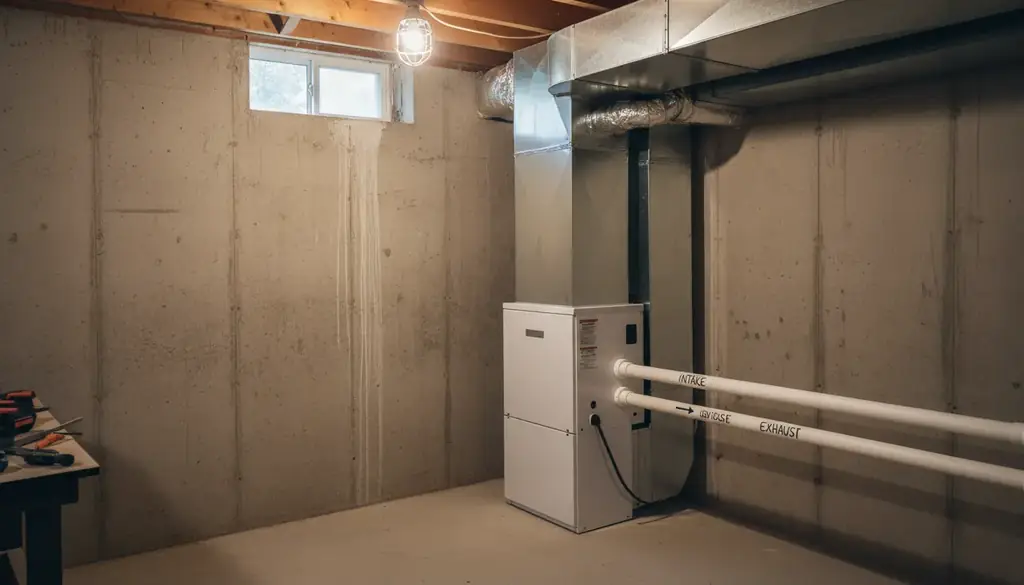
Every furnace makes some noise. A fan spins up, a burner lights, ductwork ticks as it warms. After a few winters you stop hearing it. That's exactly why a new sound stands out, and why it deserves attention instead of a louder TV.
Start with when the sound happens
Timing tells you a lot. A noise that only shows up at startup points somewhere different than one that runs the whole cycle. A sound that appears on the coldest night, when the furnace is working hardest, says something different from one you hear every single time. You don't need to name the part. Just notice what you hear and when: a bang as the burner lights, a hum that never stops, a rattle that begins a minute into the cycle. That description is worth more to a technician than a guess at the cause.
A loud noise when the furnace comes on
If your furnace is making a loud noise when it kicks on, you probably need help right away. R.A. Heating & Air Conditioning lists three possible causes. One is a defective reducer motor. Another is delayed ignition, where the burner doesn't light the moment gas arrives and the flame catches late. The third is the serious one: a cracked heat exchanger.
A cracked heat exchanger is a carbon monoxide threat. You can't see a crack from the living room, and the sound alone won't tell you which of the three you have. That's the reason a new, loud startup noise belongs in the call-now pile rather than the wait-and-see pile.
Rumbling, creaks, and rattles
A rumble is a different story, though not a better one. Rumbling from a furnace can point to dripping and burning oil, which is another potential carbon monoxide issue. If you heat with oil and you hear it, don't wait for the next cold snap to see whether it fades. Call.
Creaks and rattles are usually the milder end of the scale. They can mean a loose part. That's less urgent than a bang or a rumble, but a part that's working loose rarely tightens itself back up, so mention it.
Checks to make before you call
Some no-heat calls turn out to be simple. If the furnace won't start, run through these first. They're the same questions a dispatcher is likely to ask anyway.
- Make sure the thermostat is set to heat.
- Check the thermostat battery.
- Replace any plugged air filter.
- Unblock any outlet vents.
If the furnace runs but the house isn't warming up, adjust the thermostat and change clogged filters. Beyond that, problems like unbalanced airflow and leaky ductwork usually aren't something you can solve on your own, and they're worth a visit.
What to tell the person who answers
Say what fuel you heat with, what the sound is and when it happens, whether the furnace is still putting out heat, and what you already checked. If a carbon monoxide alarm has gone off, say that first. The more specific you are, the faster the right person can get to you.
A technician can work through the likely causes in a sensible order, starting with what's cheap and quick to rule out and moving toward the parts that matter for safety. Delayed ignition, a failing motor, and a loose part can look alike from the living room and have very different fixes. That's the value of someone who has heard each of them before: a noise stops being a mystery and becomes a short list.
Why carbon monoxide keeps coming up
All furnaces produce some carbon monoxide, usually in negligible amounts. The trouble starts when a furnace is dirty and running poorly, because the levels can become dangerous. Gas, oil, and propane furnaces burn flammable fuel, which is why careless service is risky. Electric furnaces don't burn fuel.
That's why R.A. recommends a carbon monoxide detector and alarm in every home. Put one where you'd actually hear it, replace the batteries when you're supposed to, and treat an alarm as real. If it sounds, get everyone outside and then call for help.
Why R.A. won't coach you through the repair
You'll see a line on R.A.'s pages saying it doesn't offer how-to repair service. The reason is liability and the risk of someone getting hurt. Gas, oil, and propane equipment can injure people when it's handled wrong, and a phone call can't see what's in front of you. R.A. will help you sort out what's likely going on and what to check at the thermostat, the filter, and the vents. The repair itself belongs with a technician.
R.A. has served South Central Wisconsin from Evansville since 1980, its technicians are NATE-certified, and it works on gas, electric, oil, and propane furnaces of all makes and models. If your furnace has started making a sound you don't like, see the Furnace Repair and Maintenance page, or call R.A. Heating & Air Conditioning on the main line at (608) 882-6221. Emergency calls are answered around the clock.
R.A. Heating & Air Conditioning, (608) 882-6221
Call (608) 882-6221More articles
What a 15-Point Furnace Inspection Actually Checks
A furnace tune-up is a defined list of checks, and knowing the list makes the visit easier to value.
Is Your Central Air the Wrong Size?
Sizing is the quiet decision at the center of every air conditioner replacement.